|
|
|
|
|
| |
Curcuminoids versus Cancer
Researchers find new hope in
a yellow pigment of turmeric root
|
|
| |
|
|
| |
Muhammed
Majeed, Ph.D.
|
| Vladimir Badmaev,
M.D., Ph.D. |
|
|
|
|
| |
|
|
| |
|
|
| |
|
|
| |
If the question ever were to be asked:
about what is the most promising food-derived compound
to combat cancer, the answer, based on the current
body of scientific evidence, would have to be turmeric’s
curcuminoids.
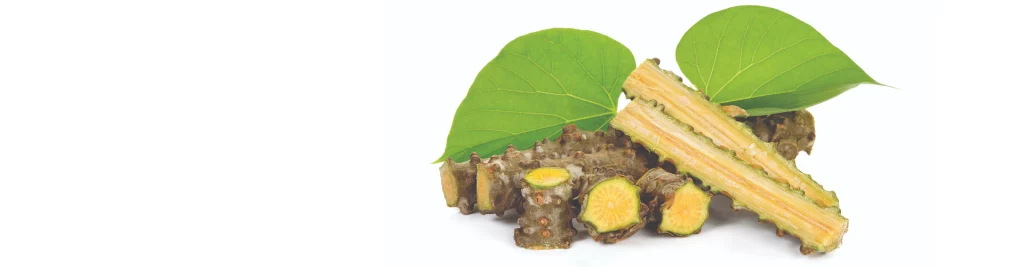
Curcumin (chemically diferuloylmethane), and its derivatives
demethoxycurcumin and bisdemethoxycurcumin, collectively
known as curcuminoids, are responsible for the yellow
pigment derived from the roots of the perennial herb
turmeric (Curcuma longa L.).
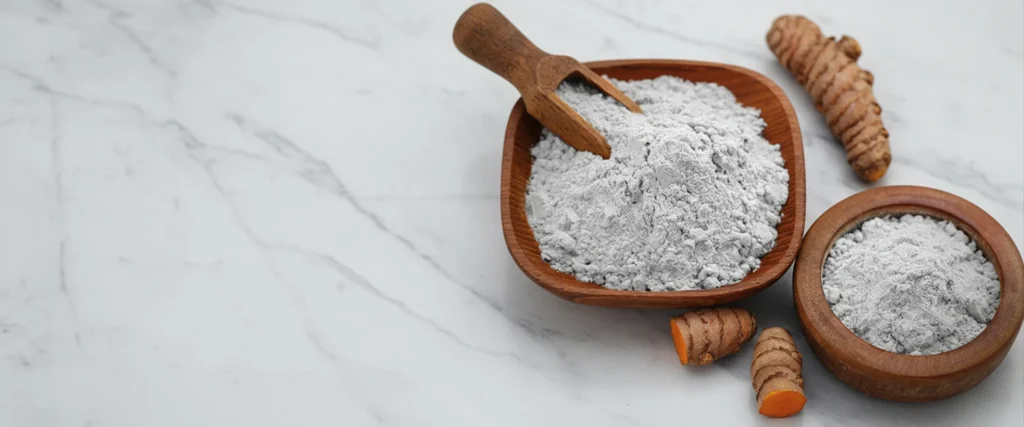
The same ground, dried roots of turmeric, which have
been used for centuries as a spice (curry), food preservative
and coloring agent, have been found to be a rich source
of phenolic compounds (curcuminoids) with versatile
biological mechanisms. In dietary supplement practice,
and in a growing body of scientific research, an extract
of turmeric roots is being utilized that is standardized
for a high purity of curcuminoids, e.g. 95% curcuminoids
(standardized curcuminoids optimized for concentration
and composition are also known by the brand name C3
Complex, which is protected by U.S. Patent 5,861,415
granted January 19, 1999).
In 1995 Dr. Richard Passwater, a foremost
authority on natural products and especially natural
antioxidants, wrote an introduction to a book on curcuminoids
which we authored (published by NutriScience Publishing).
In his foreword Dr. Passwater remarks: “At this
writing, Medline contains 193 articles on turmeric
and curcuminoids…of
interest are 16 articles on these compounds as antioxidants,
34 reports on their role against cancer, 23 on their
mechanism in reducing inflammation, five scientific
articles on their potential to reduce heart disease
and three studies on slowing the progression of HIV
infection to clinical AIDS.” |
|
| |
|
|
|
|
| |
Ten
Years Later |
|
| |
| |
Almost
a decade has passed since the already substantial
knowledge of curcuminoids’ role in prevention
and treatment of cancer was available, and the
pace of research on these compounds has only
accelerated. In the last three three years alone,
there has been at least one pioneering IND (Investigational
New Drug) study granted by the Food and Drug
Administration (FDA) and other National Institutes
of Health (NIH)-funded studies for the investigation
of curcumin and its derivatives in treatment
of patients with cancer. Some of the leading
cancer research centers in the United States,
including M.D. Anderson Hospital in Houston,
TX, are involved in pre-clinical and clinical
research of the anti-cancer mechanism and application
of curcuminoids in conditions including multiple
myeloma and colon cancer; breast, prostate, head
and neck, and respiratory tract cancers are being
considered next in line for systematic evaluation
with curcuminoid therapy.
Curcuminoids
inhibit several processes that contribute to
the survival, proliferation, invasion and metastasis
of tumor cells. These processes with which curcuminoids
interfere include signaling mechanisms (critical
for tumor growth), regulation of apoptosis (cell
death), and tumor angiogenesis (new blood vessel
formation which feeds tumors). Current research
is designed to determine which of these fundamental
processes in cancer development account for the
clinical effects of curcumin and its derivatives.
Curcuminoids have
significant immuno-modulating and anti-inflammatory
effects, in part due to their inhibition of cyclooxygenase
type 2 enzyme (COX-2) and their subsequent arachidonic
acid metabolism. Like several other immunomodulators,
curcuminoids inhibit the activation of the
nuclear factor kappa-B (NF-kB) family of transcription
factors, which are known to be activated in
a wide variety of solid tumors and leukemias.
The activation of NF-kB may shield tumor cells
from apoptosis, or programmed cell death, promote
tumor growth factors and those factors that
facilitate invasion and metastasis of tumors.
Curcuminoids block the NF-kB mediated gene expression
responsible for the chain of events leading to
tumor development, progression and expansion.
A probable mechanism of curcuminoids seems to
be blocking the phosphorylation of the inhibitors
of NF-kB. In vitro, curcuminoids induce apoptosis,
and thus inhibit tumor growth in a broad range
of tumor cells, including cell lines from colon,
breast, prostate, squamous cell, renal cell,
hepatocellular carcinomas, B and T-cell lymphomas,
leukemias, melanoma and sarcoma cells.
Curcuminoids also affect a signaling mechanism
that involves expression and activation of
certain receptors of growth factors that promote
tumor growth. For example, HER-2/neu is a member
of the Epidermal Growth Factor Receptor family,
which is overexpressed in approximately 30%
of breast cancer patients. HER-2/neu breast
cancer cells, when exposed to curcuminoids,
inhibited the expression of the HER-2 receptor.
Interestingly, curcuminoids may have a comparable
mechanism of action to the recently approved
drug therapy involving Herceptin for breast
cancer patients with HER-2 receptor positive
cancer cells. Herceptin is an antibody against
HER-2 receptors; binding, blocking and inactivating
those receptors. In addition, in vitro, the
growth of breast cancer cells with multi-drug
resistance (MDR) characteristics is inhibited
by turmeric phenolics; the stimulation of estrogen
receptor (ER) positive cell lines by estrogenic
pesticides is also inhibited by curcuminoids.
Curcuminoids have also been found to inhibit
epidermal growth factor receptor expression
and/or activation in skin cancer cell lines
as well as in androgen-sensitive and androgen-insensitive
prostate cancer cell lines.
|
|
|
| |
|
|
|
|
|
| |
Starving
the Tumor |
|
| |
| |
One of
the important anti-cancer mechanisms of curcuminoids
is due to constriction of vital blood supply
to the rapidly growing tumor. These compounds
inhibit in vitro the vessel endothelial and smooth
muscle cell growth and proliferation, which is
the basis for inhibition of angiogenesis (new
blood vessel formation). Curcuminoids also inhibit
new vessel formation induced by growth factors,
such as fibroblast growth factor-2 (FGF-2).
Furthermore, curcuminoids inhibit the production
of vascular endothelial growth factor (VEGF) in
human melanoma cells. The anti-angiogenic effect
of turmeric compounds can be explained due to the
aforementioned selective COX-2 inhibition with
curcuminoids. The COX-2 enzyme activity may actually
contribute to tumor growth (inhibition of apoptosis)
along with increased production of the new vessel
growth factors (VEGF, FGF) and the formation of
new blood vessels. An in vivo study showed tumor
regression in response to cyclooxygenase inhibitors
in experimental models of human colon, prostate,
gastric, lung and certain types of head and neck
tumors. In in vitro experiments cyclooxygenase
inhibitors inhibited the growth of human pancreatic,
liver and breast cancer cell lines.
While human trials involving curcuminoids are
still limited, in animal models curcuminoids
have been shown to prevent tumor formation
in genetically predisposed animals, i.e. animals
prone to develop precancerous multiple intestinal
adenomas, a model for the human condition known
as Familial Adenomatous Polyposis (FAP). Dietary
enrichment with curcuminoids inhibited polyp
growth in these animals by over 60%. A study
with human subjects is currently under way
evaluating the effects of curcuminoids on Aberrant
Crypt Foci (ACF) development in the colon. Curcuminoids
were also successfully tested in several other
intervention trials. In one experiment mice inoculated
with melanoma cells responded to dietary curcumin
intervention with a reduction in the number of
lung tumor nodules by 90% as compared to sham-fed
controls.
In the late 1980s, a Phase I chemopreventive
study of curcuminoids administered orally was
performed in a selected group of patients with
a high risk of developing bladder cancer, Bowen’s Disease,
cervical cancer, and premalignant conditions such
as oral leukoplakia (an inflammatory precancerous
condition of the oral cavity) and intestinal metaplasia
(premalignant transformation of tissue) of the
gastric mucosa (stomach lining). The premalignant
state improved in seven of the 25 patients, and
no adverse effects related to curcuminoids use
were observed. Several other chemoprevention trials
focusing on the use of curcuminoids are currently
under way.
The National Toxicology Program of the National
Institute of Environmental and Health Sciences
evaluated the safety of turmeric oleoresin containing
concentrated and standardized levels of curcuminoids
at the request of the National Cancer Institute
and the FDA. No biologically significant differences
in hematologic (blood parameters), clinical chemistry
or urinalysis parameters were noted between the
experimental and control animals in the 13-week
studies. The turmeric oleoresin used was found
to be non-mutagenic. The LD50 in rats was higher
than 3,500 mg/kg. Monkeys given doses up to 800
mg/kg/day for three months exhibited no adverse
effects on growth, behavior and biochemical parameters.
The U.S. FDA includes turmeric powder and oleoresin
on its list of substances generally recognized
as safe (GRAS).
The
well recognized and documented properties of
curcuminoids in inhibiting the COX-2 enzyme,
coupled with the history of safe use as food
and dietary supplement qualifies these turmeric
derived compounds for further clinical trials
in cancer prevention and intervention. The
use of anti-inflammatory compounds is of
particular interest now, not only in the
prevention of cancer, but also in the treatment
of full-blown cancer. For example, in a 1990s
study performed in Sweden, patients with
advanced metastatic solid tumors benefited
from NSAID anti-inflammatory therapy by a
mean survival of 510 days compared to 250
days for the placebo group, and also maintained
a better quality of life in the course of the
disease. WF
Vladimir Badmaev, M.D., Ph.D.,
is vice president of scientific and medical affairs,
and Muhammed Majeed, Ph.D., is the C.E.O. of
Sabinsa Corporation, headquartered in Piscataway,
NJ.
|
|
|
| |
|
| |
|
|
|